I’ve spent more than a decade helping broadcasters and first responders stay connected when things go wrong. Before that, I ran 911 calls as an EMT. So when someone asks me what makes a connectivity solution mission-critical, my answer is pretty simple: what happens when one of your network connections drops?
Not peak speed. Not feature counts. What happens when things break?
That’s why a recent third-party benchmark stopped me in my tracks.
What the Lab Found
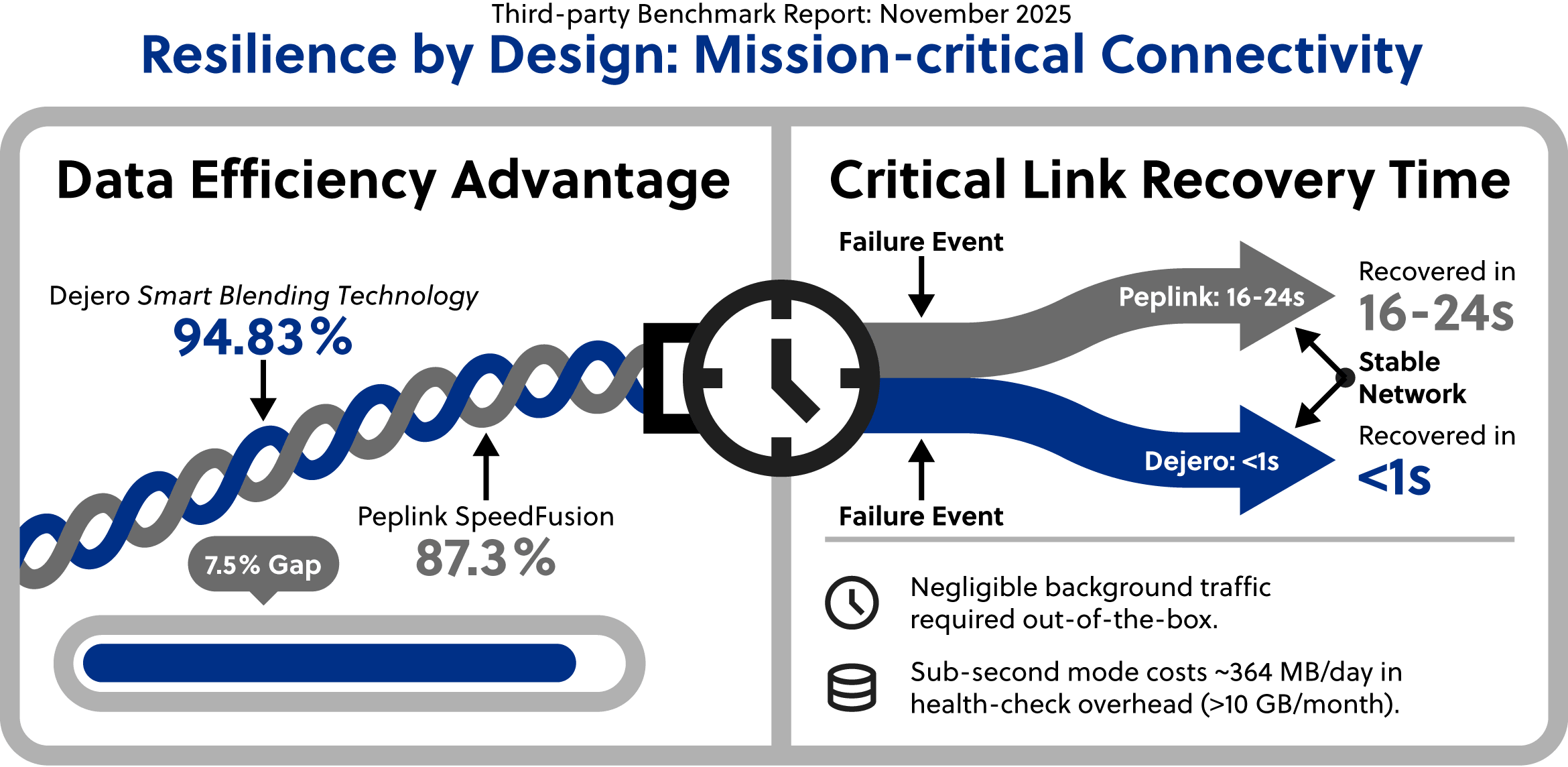
IP Access International runs something called The Truth Lab, a controlled testing environment designed to strip out the marketing and measure how connectivity platforms actually behave under stress. Their first test (Truth Lab Test #001, December 2025) put Dejero Smart Blending Technology™ and a competitor (Peplink SpeedFusion) head-to-head under identical conditions, using default configurations, the same network connections, and real application traffic.
Two numbers stood out.
Efficiency: 94.83% vs. 87.3%
Dejero converted 94.83% of available capacity into usable application bandwidth. The competitor converted 87.3%. That 7.5% gap doesn’t sound dramatic, until you’re operating on a metered satellite link in a wildfire zone or a cellular-congested stadium. Every point of overhead is bandwidth you’re paying for and not getting.
Recovery: under one second vs. 16–24 seconds
Out of the box, Dejero recovers from a link failure in under a second, with negligible background traffic. The competitor’s default recovery window is 16–24 seconds.
To put that in context: a lot can happen in 16 seconds. A firefighter loses situational awareness on a TAK feed. A live shot drops mid-broadcast. A 911 dispatcher’s screen goes dark. These aren’t hypothetical risks, they’re the exact scenarios my customers prepare for every day.
The competitor does offer a sub-second recovery mode. But it comes at a cost: approximately 364 MB per day in health-check overhead, which translates to more than 10 GB per month. On a metered satellite link, that’s not a configuration tweak, that’s a budget line item.
Architecture Matters
I want to be clear: the Truth Lab isn’t declaring a winner, and neither am I. What this test does is show the real-world cost of architectural choices.
Dejero Smart Blending Technology moves traffic packet by packet across the best available path at any given moment, prioritizing whatever your mission demands, usually latency, for my customers. That approach means the system is already compensating for a failing link before most platforms have detected the problem.
That design philosophy doesn’t show up on a spec sheet. It shows up in a lab test at 2 AM when conditions go sideways.
Why This Matters for Your Mission
Whether you’re running a mobile command post at a multi-agency incident, keeping a news crew live from a red carpet, or managing real-time data for search and rescue teams, the question is the same: what does your connectivity do when one of your network paths goes down?
If the answer involves a 16-second window, that’s worth knowing before you deploy, not after.
I’m proud that an independent test confirmed what our customers have been telling us for years. And I think it’s worth sharing because the agencies and broadcast groups we work with deserve data, not just demos.
What’s your hardest connectivity challenge?
Bring us your connectivity challenge and we’ll show you what’s possible.