Two Gold Stevie® Awards. Company of the Year – Telecommunications, for “Dejero: Redefining Mission-Critical Connectivity for the Telecommunications Era,” and Technology Breakthrough of the Year, for “Dejero TITAN: World’s First Triple 5G Mission-Critical Connectivity Platform.” Both will be celebrated at the awards ceremony in Paris on October 28. I read the results twice, then pulled up our entry to reread everything we’d rewritten to get there.
Learning to Tell a Sharper Story
The first draft of our Stevie entry read like a spec sheet with a pulse problem. Three 5G modems. Packet-level blending. FedRAMP authorization. All true, all impressive to the right audience, and all beside the point if you can’t answer the one question every judge is quietly asking: so what?
So we went back to the field.
We built the entry around a white paper, “Beyond Bonding: Redefining Mission-Critical Connectivity,” and a video anchored in a 640-mile road test our own Dean Taylor, Director of Technical Account Management, ran from Memphis, Tennessee to Savannah, Georgia. Not a lab demo. A stretch of interstate and a competing 5G router that gave up entirely, its upload throughput collapsing to under 1 Mbps while TITAN Command never lost a single connection. Blended uptime held at 98% against a best single carrier of 58%, and as low as 35% on the weakest one, a 2.6x reliability improvement. When one connection spiked to nearly two full seconds of latency mid-drive, Dejero Smart Blending Technology™ rerouted around it so fast the effective peak barely touched half a second, a 71% reduction. Even crawling through Atlanta rush-hour traffic, with individual carriers losing 46 to 72% of their data on tower handoffs, the blended connection never dipped below 220 Mbps.
That’s the story that moved the judges. Not the spec sheet. The interstate.
What the Judges Saw, and What We’re Already Proving
One judge called the field data “outstanding evidence.” Another wrote that TITAN “redefines critical network infrastructure,” backed by “exceptional, undeniable field-test validation.” A third told us the architecture “goes deeper than I expected,” and that our FedRAMP Moderate authorization, secured with U.S. Customs and Border Protection as sponsoring agency, was “hard to fake.”
I’ll take it.
The judges also handed us a punch list: more named customer deployments, more adoption metrics, and independent third-party validation of our “industry first” claims, not just our own confidence in them. Fair feedback. It also turns out we had more of an answer than our entry let on.
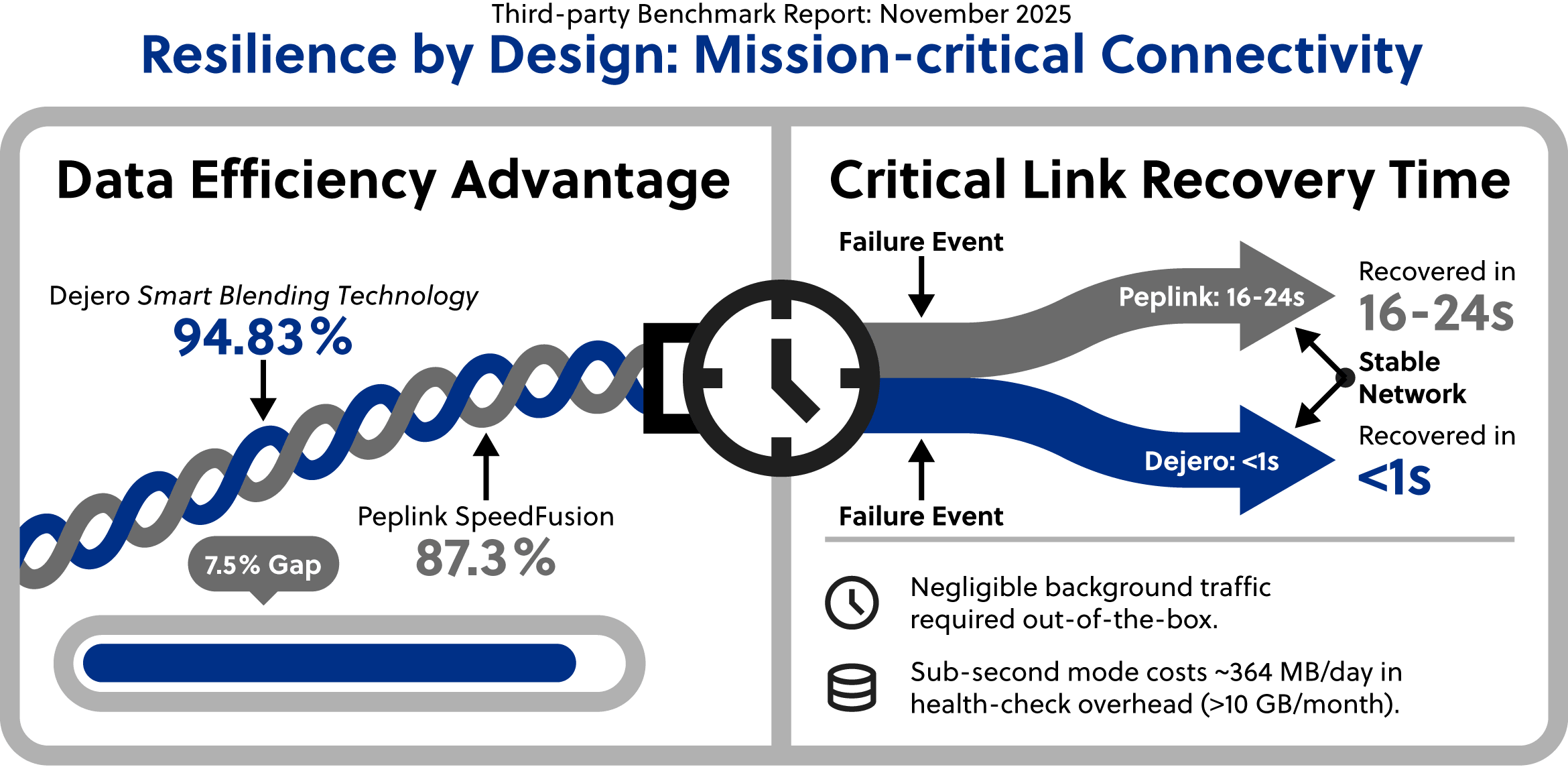
Dejero Smart Blending Technology, the core of everything TITAN runs on, has already been independently tested. IP Access International’s Truth Lab put our GateWay platform head-to-head against a competing bonding solution under identical lab conditions in late 2025. Dejero delivered 94.83% of available capacity to real applications, against 87.3% for the competitor, and recovered from a dropped link in under a second, by default, with no tuning required. The competitor needed an aggressive configuration change just to match that recovery speed, and paid for it with roughly 364 MB a day in background overhead. We simply didn’t have that data in front of the judges the first time around.
And the adoption story is already writing itself. TITAN’s first production run sold out, and customers are deploying it in the field right now. We didn’t have those stories ready when we submitted this entry. We will next time.
Two Wins, One Thread
TITAN’s Stevie nominations landed the same year we actually took the platform to market. TITAN Command made its worldwide debut at ISE 2026 in Barcelona. TITAN Mobile followed with its North American debut at the Texas Division of Emergency Management Conference, built for the fleets and first responders who can’t afford the kind of dropped signal our competitor’s router gave us on that Georgia interstate. TITAN Scout and TITAN Ghost round out the family before the year is out.
One judge called it “a genuinely standout innovation, a first of its kind.” Another put it more simply: “Dejero is setting a new standard for connectivity in the most demanding environments on Earth.”
I’ve spent a good chunk of my time at Dejero building this product brand family, from naming to trademark to launch. Reading that sentence from someone with no reason to be kind to us, and every reason to be rigorous, is the kind of validation you can’t manufacture.
The Full Circle
Here’s the part that actually got me, more than either trophy.
The same night we collect Gold for Company of the Year and Technology Breakthrough of the Year in Paris, Dejero is also collecting a Gold Stevie for Employer of the Year – Telecommunications and a Bronze Stevie for Achievement in Organizational Culture, both from the Stevie Awards for Great Employers. Four trophies, one gala, one company recognized for the technology and the team that built it in the same breath.
Add in Waterstone Human Capital’s Canada’s Most Admired Corporate Cultures™, our #2 ranking in North America in the Inspiring Workplaces Awards, and nine consecutive years as a certified Great Place to Work®, and it stops looking like a coincidence.
It’s one thing to build something judges call an industry first. It’s another thing entirely to build the team behind it, and to have that team recognized in the same breath, at the same ceremony, by the same judges. The people who spent a week road-testing routers across Georgia and Tennessee, who rewrote a white paper until the story finally had a pulse, who show up for each other on the unglamorous Tuesdays between award seasons, that’s the same culture the workplace awards are measuring.
Gold for the product. Gold for the people who made it. That’s the full circle I actually care about.